
Why Christmas Trees Smell Different
I’m α-pinene (alpha-pinene).
When a fresh Christmas tree comes through the door, you might recognize my sharp, resinous note before you’ve taken off your coat. Stay a moment and you may catch something citrusy or balsamic, too. Concolor fir, Norway spruce, and Douglas-fir can all smell like Christmas, each with a different blend of volatile compounds.

Five true firs, five blends
A 2025 study profiled needle and stem chemistry in five true firs and asked consumers to rate their aromas. The researchers detected limonene and bornyl acetate in all five, and α-pinene levels varied across species. Fraser fir (Abies fraseri) earned the highest liking score, while concolor fir (A. concolor) smelled strongest. Nordmann (A. nordmanniana) and Trojan (A. equi-trojani) fir fell between Fraser and noble fir in liking, and noble fir (A. procera) received the lowest liking score in this panel. Read the five-fir study.
Bornyl acetate, an oxygenated monoterpenoid with a piney, herbal scent, was positively associated with liking in the panel. I didn’t show that same positive association. The researchers found several other compounds associated with liking, too. To learn which ones actually change how much people like the scent, you’d need to vary them in a blend and test it again. See the chemical and sensory results.
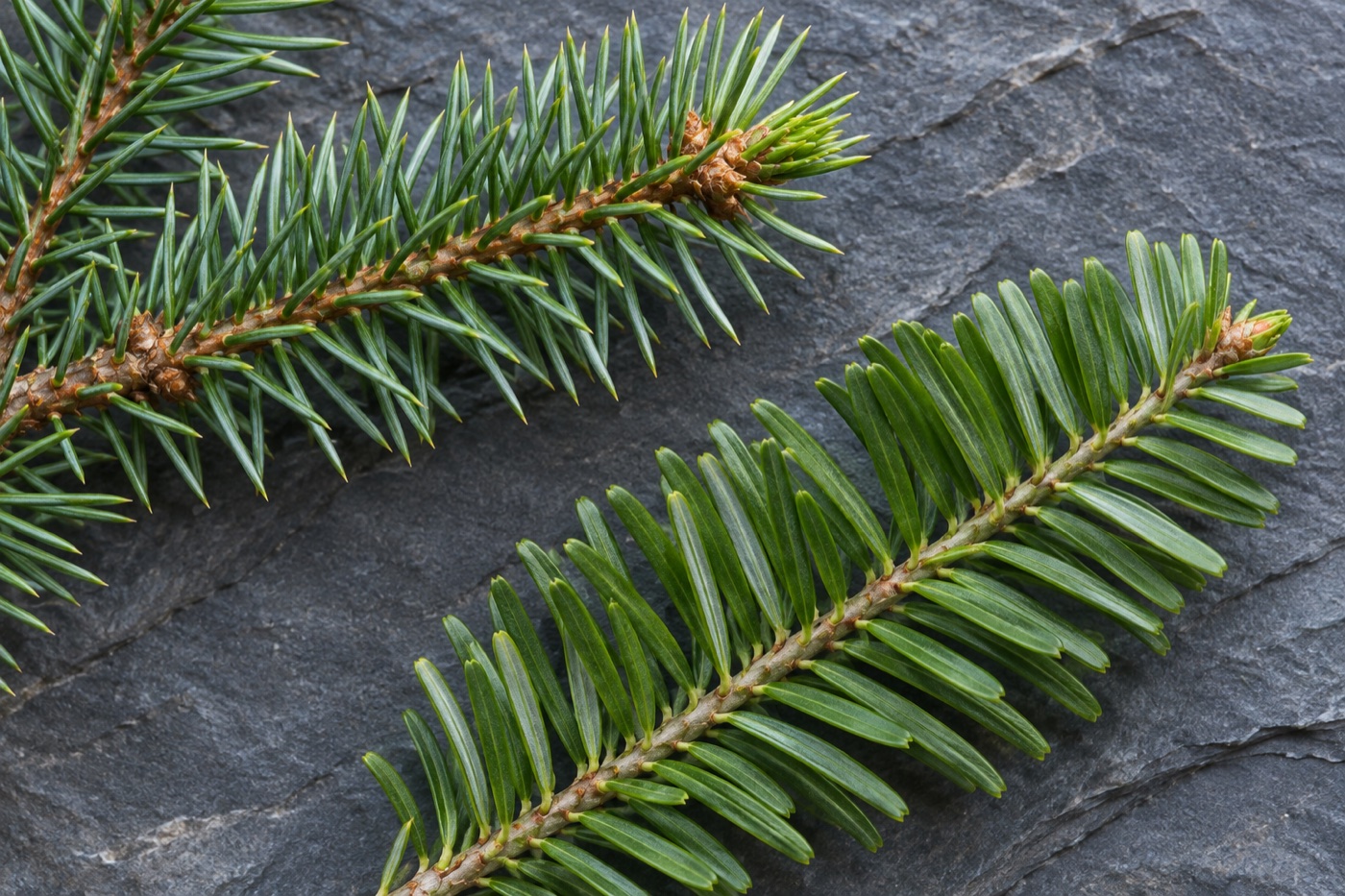
Balsam fir and Norway spruce share some ingredients
In one analysis of balsam fir (Abies balsamea) essential oil, β-pinene made up 38% of the oil, δ-3-carene 12%, and bornyl acetate 9%. β-Pinene and I have the same molecular formula, C₁₀H₁₆, and a different arrangement of bonds. The Greek letter matters when you’re reading a chemical profile. Read the balsam fir oil analysis.
Norway spruce (Picea abies) has a seasonal story. In one study of distilled shoot oil, bornyl acetate accounted for about 18% of the oil in April and 4% in June. Limonene ranged from about 1% in June to 9% in November. Those percentages describe the distilled samples. They give us a window into how the plant’s chemistry changes through the year. Read the seasonal spruce study.
What a cut Douglas-fir puts into the air
Douglas-fir (Pseudotsuga menziesii) belongs to a different genus from the true firs. To measure what reaches the air, NIST researchers put one freshly cut Douglas-fir in a chamber for 17 days. Monoterpene emissions peaked at 12.4 milligrams per hour on day one and dropped to about 1 milligram per hour by day three. On day 17, limonene accounted for roughly 63% of the instrument signal the researchers used to track the monoterpene mixture. That’s a late measurement from one tree, when total emissions were already much lower. Read the Douglas-fir chamber study.
At the tree lot, ask for the species name and take a sniff. Try to pick out the resinous note first, then see if you catch anything citrusy or herbal. Smell the same tree again a few days after you bring it home. I may be the note you recognize first. The species and the days since cutting help decide what else you’ll smell.