
What Burns in a Hanukkah Lamp?
The terpenes in olive oil and what happens when the wick catches.
In the Talmud’s account of Hanukkah, the people rededicating the Temple found one sealed vessel of oil, enough to light the menorah for a single day. It lasted eight.
A few pages later, Rabbi Yehoshua ben Levi singles out olive oil as the preferred oil for the Hanukkah lamp. I’m squalene, one of the molecules in that oil. Follow me from the cup to the flame. 1
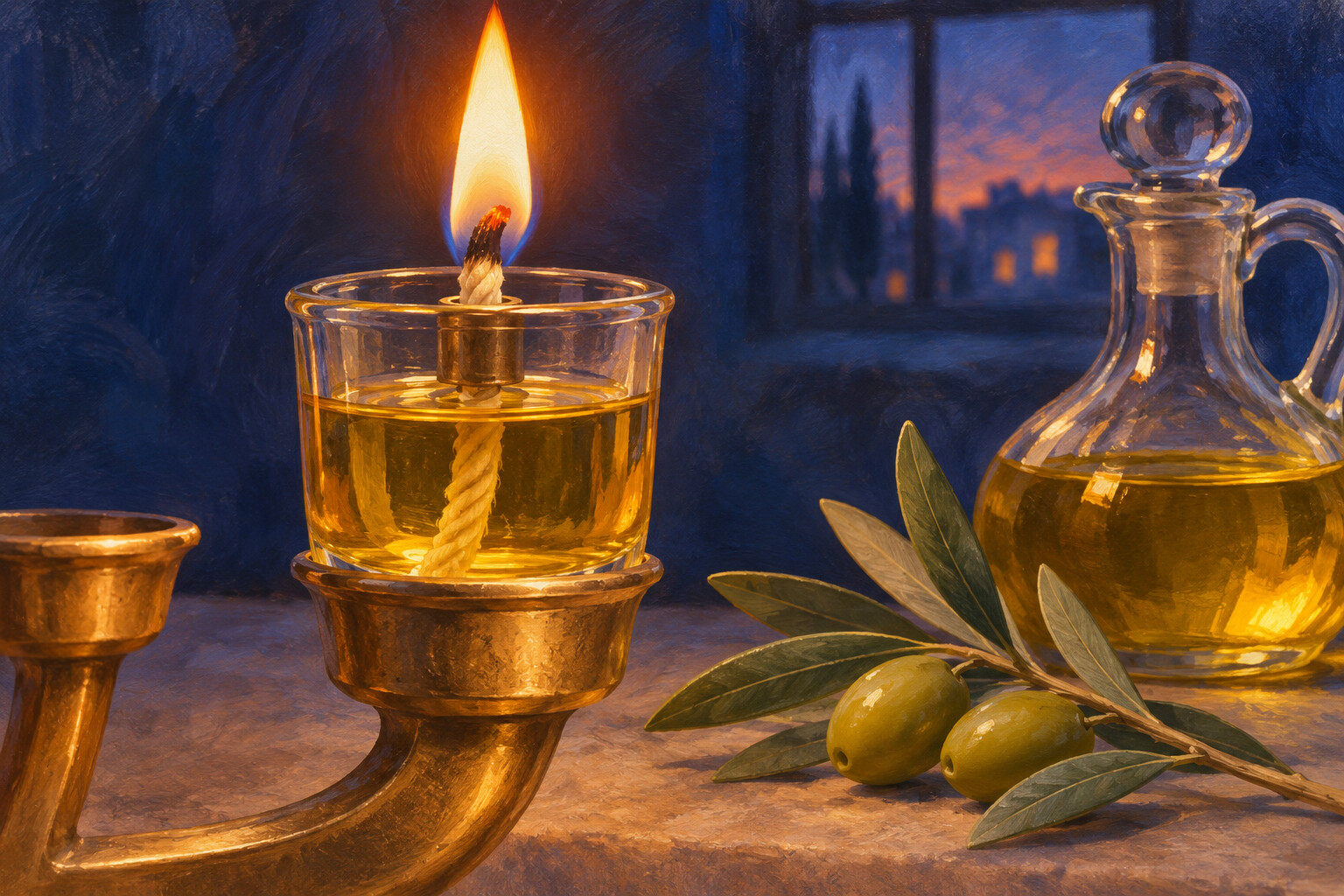
An olive-oil light at dusk.
Who’s in the oil with me?
Most oil pressed from the olive tree (Olea europaea) is made of triglycerides. Each holds three fatty acids joined to a glycerol backbone. Many of those fatty acids are oleic acid. I’m a 30-carbon hydrocarbon with six double bonds. In one cultivar survey, virgin oils contained 110–839 milligrams of squalene per 100 grams of oil. The average was about half a percent by weight. 2
- Monoterpenes (10 carbons). α-Pinene and limonene have been detected among the volatiles above extra-virgin olive oil. The mix varies among oils. 3
- Sesquiterpenes (15 carbons). Caryophyllene has also been detected in extra-virgin olive oil volatiles. 3
- Triterpenoid acids (30 carbons). One virgin oil made from Picual olives contained about 47 mg/kg of maslinic acid and 39 mg/kg of oleanolic acid. 4
At the wick, the oil changes
In an experimental archaeology study, replica lamps burning olive oil left far less soot on the collection paper than lamps burning walnut or linseed oil in the same series. The experiment measured soot deposits. Measuring carbon monoxide in the air or tracing what happens to individual terpenes would require sampling the exhaust. 5
Capillary action draws liquid oil up the wick. Near the tip, heat produces vapors and breakdown products that react with oxygen. The triglycerides supply most of the fuel. Tiny hot soot particles can glow yellow inside the flame, and some can escape or settle on nearby surfaces. 6 7
From oil to air
- Reservoir. Liquid oil holds triglycerides and minor terpenes.
- Wick. Capillary action draws oil toward the flame.
- Flame. Heated fuel breaks down and reacts with oxygen.
Carbon dioxide and water vapor
Carbon monoxide and soot
Where the carbon goes
Combustion is a heat-driven chemical process. Triolein, an olive-oil triglyceride with three oleic acid chains, gives us a model for tracking the fuel’s carbon.
- Fuel enters the hot zone. Triolein (C57H104O6) breaks down into smaller fragments.
- Fragments react with oxygen. Given sufficient oxygen and time at high temperature, carbon is oxidized to carbon dioxide and hydrogen to water. Some carbon can leave as carbon monoxide or soot when oxidation is incomplete.
- Count the atoms. The net equation for complete oxidation of one triolein molecule is
C57H104O6 + 80 O2
→ 57 CO2 + 52 H2O
From the wick to the latke pan
Olive oil can change in a hot frying pan even without a flame. Its fatty acids can oxidize and break into smaller molecules. In controlled cooking experiments, researchers detected aldehydes including acrolein, hexanal, and nonanal in fumes from heated olive oils. Those measurements describe cooking conditions. Direct exhaust sampling would be needed to find out which aldehydes escape an olive-oil wick and in what amounts. 8
At a Hanukkah table, you might meet me twice. In the pan, I’m in the oil that carries heat to the potatoes. At the wick, I’m in the fuel that gives the room its light. Happy Hanukkah.
References
- Babylonian Talmud, Shabbat 21b and Shabbat 23a.
- Squalene in virgin olive oil across cultivars.
- Volatile profiles of extra-virgin olive oils.
- Composition of the Picual oils, Table 1.
- Broisch-Höhner’s replica-lamp and soot study.
- Milwaukee Public Museum on oil lamps.
- Wick-lamp combustion and soot, studied with kerosene.
- Fullana and colleagues on aldehydes in olive-oil cooking fumes.